
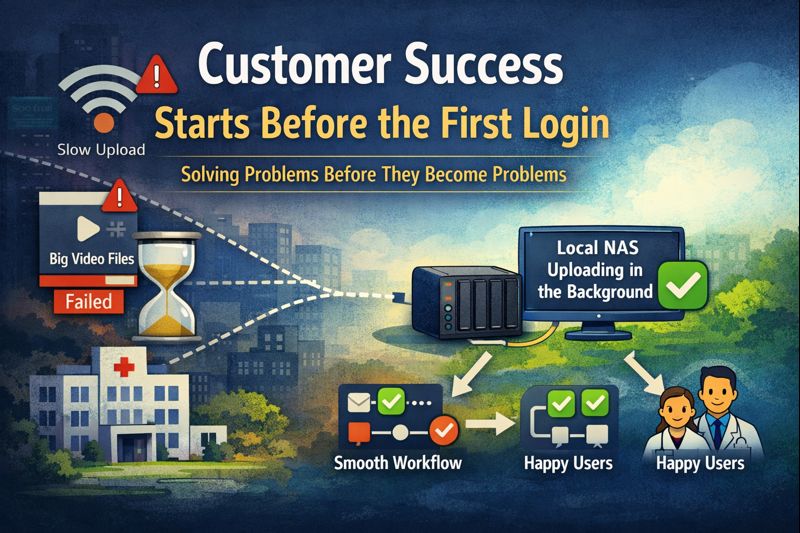
Most people think customer success starts when someone logs in and asks a question.
Nah.
Customer success starts before that—when you’re planning how this is actually going to work in the real world… with real people… inside real environments… that were not designed for your product.
Because here’s the uncomfortable truth:
A great platform can still fail if the workflow is annoying enough.
And the #1 silent killer I run into over and over again is not attitude, not training, not “buy-in”…
It’s friction.
The situation: hype meets reality
A hospital team was excited to get started with a video-based analytics platform. Strong champion. Clear purpose. Everyone was aligned.
On paper, it was simple:
- upload cases
- review insights
- build a library
- scale it across the team
But within the first couple of steps, we hit a landmine that I’ve learned to sniff out early:
internet speed.
And I don’t mean “my Zoom froze for two seconds” internet speed.
I mean the kind of speed that turns a basic workflow into a full-time job:
- uploads that fail halfway through
- staff babysitting progress bars
- “we’ll try again later” turning into “we haven’t touched it in three weeks”
That’s the danger zone.
Because when a customer starts associating your product with pain, you’re done—no matter how good it is.
Here’s how I think about CS
I don’t think of Customer Success as “being helpful.”
I think of it as: engineering momentum.
My job is to make the first wins inevitable, not theoretical.
And that always starts with two moves:
- plan for success
- remove obstacles
Not in a motivational poster kind of way. In a nuts-and-bolts way.
Step 1: Plan for success (aka: stop winging it)
Before we did anything, I asked a question I ask on basically every rollout:
What’s the first real “moment of value” we’re aiming for?
Not “accounts are created.”
Not “training is done.”
Not “they said it looks cool.”
The real milestone was:
a set of cases successfully ingested and ready to review… without drama.
Then we listed what could block that milestone.
And the answer was obvious.
The blocker: big files + slow/unstable internet = death by a thousand cuts
If uploading is slow, people don’t just get delayed. They get frustrated.
And frustrated people do what humans always do:
they deprioritize the thing that caused the frustration.
So instead of pretending bandwidth wouldn’t matter, we dealt with it head-on.
Step 2: Remove the obstacle (don’t blame the customer)
This is where implementations go sideways.
Teams say stuff like:
- “Just upload overnight.”
- “Try a different network.”
- “Maybe IT can increase bandwidth.”
That’s not a strategy. That’s a prayer.
So I pushed for a workaround that made the workflow reliable regardless of internet speed.
The workaround: a NAS-based workflow that runs in the background
We set up a process where the hospital used a NAS (Network Attached Storage) as a staging point for their videos.
And this changed everything.
Instead of staff trying to upload massive files directly and watching the progress bar like it’s a heart monitor…
They could move videos locally to the NAS (fast, reliable), and then:
The NAS uploads in the background, passively.
No babysitting. No drama. No “it failed again.”
Just a quiet system doing its job while people do theirs.
This is my favorite type of Customer Success win:
We didn’t change the product.
We changed the path to success.
What happened after that (this is the important part)
Once that upload bottleneck disappeared, the whole relationship changed.
- The team stopped dreading the process.
- Progress became predictable.
- We got out of “setup mode” and into “value mode.”
- And most importantly: momentum started building.
Predictable progress builds trust fast.
And trust is what gets you from:
“we tried it once” → “we rely on this.”
The takeaway: CS is systems design
Customer Success isn’t cheerleading. It’s not “checking in.” It’s not sending friendly emails with smiley faces.
It’s systems design.
It’s looking at the real environment and asking:
What is most likely to derail this in the first 30 days?
Then removing that problem before it becomes the customer’s lived experience.
Because the fastest way to lose a customer isn’t a bad product.
It’s a good product trapped behind a workflow that feels like a chore.
And if you’re in CS (or building a product), remember this:
People don’t churn because they “didn’t understand the value.”
They churn because the path to value was too painful to walk.
Comments are closed