
Most people hear “Customer Success” and think it means being friendly, answering emails fast, and jumping on calls when someone’s confused.
That’s part of it… but it’s not the job.
Customer Success Management (CSM) is really this:
Turning a signed contract into real outcomes—reliably—so renewals become obvious and growth becomes repeatable.
If Sales is the promise, Customer Success is the delivery system.
And if you run CS like a system (not a scramble), you get three things every company wants:
- adoption that sticks
- customers who renew without drama
- expansion that feels earned, not pushed
Here’s how I think about customer success management—and how I run it.
The biggest misconception: CS is support
Support is reactive:
Customer reaches out → you solve the issue.
Customer Success is proactive:
You design a path so the customer doesn’t get stuck in the first place.
Support is “fix the problem.”
Success is “remove the obstacles that create the problem.”
A good CSM isn’t just helpful. They’re strategic. They see the next 30 days before the customer does.
Customer success is a pipeline, not a department
This is the moment most people level up in CS: realizing success has stages.
Customers don’t magically “become successful.” They move through a sequence.
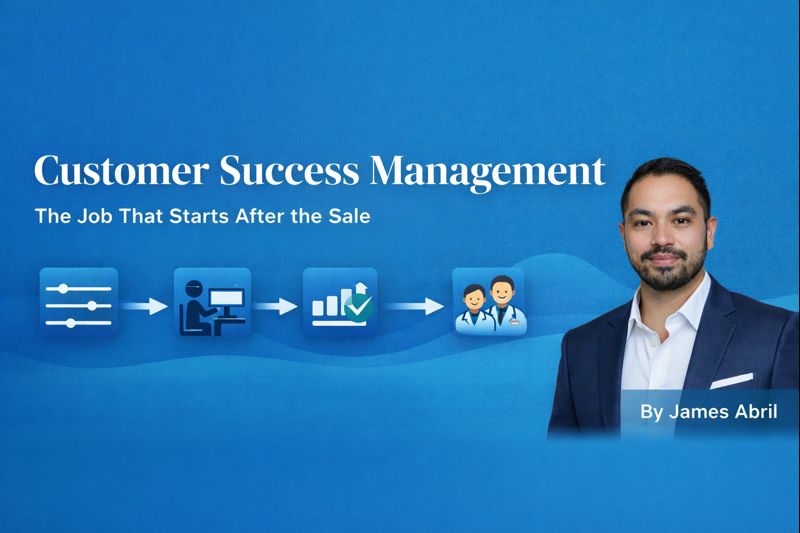
A simple customer success pipeline looks like:
- Setup – access, permissions, integrations, logistics
- Activation – first real workflow completed
- Adoption – usage becomes consistent (a habit)
- Outcomes – results show up that matter to the customer
- Expansion – additional users, sites, workflows, volume
- Renewal – a non-event because value is proven
If you don’t manage these stages, you end up managing chaos:
- customers drifting
- check-in calls with no progress
- last-minute renewal panic
- “we love it but we didn’t have time to use it”
CSMs don’t just manage accounts. They manage movement.
It starts with planning for success (before anyone logs in)
The smartest CS work happens early.
Before the customer gets a password, I want answers to three questions:
1) What does “success” mean for them?
Not vague stuff like “efficiency” or “better workflow.”
I want something measurable:
- “Complete X workflow end-to-end”
- “Get Y result within 30 days”
- “Reduce time spent on Z”
- “Train N people and make it routine”
2) Who actually owns the outcome?
Champions are great, but you also need:
- the person who has authority
- the person who does the work day-to-day
- the person who gets blamed if it fails (yes, that person matters)
3) What will slow this down?
This is where real Customer Success lives.
Common early killers:
- IT/security approvals dragging
- unclear data/process ownership
- workflow friction (“this is annoying”)
- internal politics (“not my job”)
- slow internet, slow devices, slow file transfers
- “we’ll get to it next month”
A good CSM doesn’t ignore these. They go hunting for them.
The CSM toolkit: remove friction, create momentum
You can have the best onboarding deck on Earth and still fail if your customer’s environment makes success painful.
So my approach is simple:
Remove obstacles first. Then ask for effort.
Because effort without momentum turns into resentment.
Momentum turns into habit.
The “First Win” rule
I always aim for an early win that:
- happens quickly
- proves value
- reduces anxiety
- makes the customer want the next step
The first win is not “training complete.”
The first win is “we used it in real life and it worked.”
What great customer success looks like in practice
Here are the behaviors I associate with strong CSMs:
1) They run a cadence, not random check-ins
A “check-in” is a meeting that often produces… nothing.
A success cadence is structured:
- what we achieved
- what’s blocking progress
- what we’re doing next
- what success looks like by the next call
Progress should be visible, not assumed.
2) They measure adoption like a grown-up
You don’t need 50 metrics.
You need the ones that tell the truth:
- time-to-value (how long until the first real outcome)
- activation rate (how many reach the value milestone)
- weekly active usage (is it becoming a habit)
- depth of use (are they using core workflows)
- breadth of use (how many users/teams are involved)
CS without measurement becomes storytelling.
3) They close loops
Customers lose trust when they report problems and nothing happens.
Great CSMs close loops:
- with the customer (“here’s what changed”)
- with Product (“here’s what keeps showing up”)
- with GTM (“here’s what messaging lands / doesn’t land”)
Closing loops is how you turn customer conversations into product improvement and revenue retention.
Renewals shouldn’t be a fire drill
If you’re assembling a frantic “value deck” 60 days before renewal, it usually means one thing:
Value wasn’t consistently proven.
Renewals become easy when:
- outcomes are documented continuously
- customers can point to wins
- usage is habitual
- key stakeholders see the impact
The best renewal call is basically:
“Here’s what we achieved, here’s what’s next, and here’s how we scale it.”
What makes a CSM valuable (and hard to replace)
The best customer success managers aren’t just personable.
They’re:
- systems thinkers
- great communicators
- calm under pressure
- obsessed with removing friction
- able to translate between customer reality and internal teams
- focused on outcomes, not activity
They turn complexity into clarity.
And in a world where every product claims to be “easy,” the person who can make success inevitable is the person every company needs.
My simple definition of the job
If I had to define Customer Success Management in one line, it would be:
A CSM builds a repeatable path to outcomes—and keeps customers moving on it.
That’s it.
That’s the job.
Comments are closed